
Table of Contents
ToggleElementary school strategies shape how young students learn, grow, and develop critical skills. Teachers and parents who understand these strategies can create environments where children thrive academically and emotionally. The right approach during these formative years sets students up for long-term success.
This article explores proven elementary school strategies that work. From structured routines to active learning techniques, each method serves a specific purpose in student development. These approaches help educators meet diverse learning needs while building confident, capable learners.
Key Takeaways
- Structured routines reduce anxiety and maximize learning time by giving elementary students the predictability they need to stay focused.
- Active learning techniques—such as hands-on activities, brain breaks, and collaborative projects—boost retention and keep young learners engaged.
- Differentiated instruction allows teachers to meet diverse learning needs by offering multiple pathways to the same educational goal.
- Social-emotional development is just as important as academics; teaching children to manage emotions and build relationships creates stronger learners.
- Elementary school strategies work best when parents and teachers partner together through consistent communication and home-based learning support.
- Flexible grouping and ongoing assessments help educators adjust instruction based on each student’s current needs and progress.
Building a Strong Foundation Through Structured Routines
Structured routines give elementary students the predictability they need to feel safe and focused. Children perform better when they know what to expect throughout their school day. Effective elementary school strategies start with consistent schedules that reduce anxiety and increase learning time.
Morning routines set the tone for the entire day. Teachers can establish a greeting ritual, a quick warm-up activity, and a clear transition into the first lesson. These patterns help students shift from home mode to learning mode within minutes.
Classroom procedures also matter. Students should know exactly how to:
- Turn in assignments
- Request help from the teacher
- Transition between activities
- Handle materials and supplies
When routines become automatic, students spend less mental energy figuring out logistics. They can direct that energy toward actual learning instead. Research shows that classrooms with strong routines lose fewer instructional minutes to behavioral disruptions.
Teachers should introduce routines gradually and practice them explicitly. Modeling the expected behavior, then having students rehearse it, creates lasting habits. Elementary school strategies work best when students understand both what to do and why it matters.
Engaging Students With Active Learning Techniques
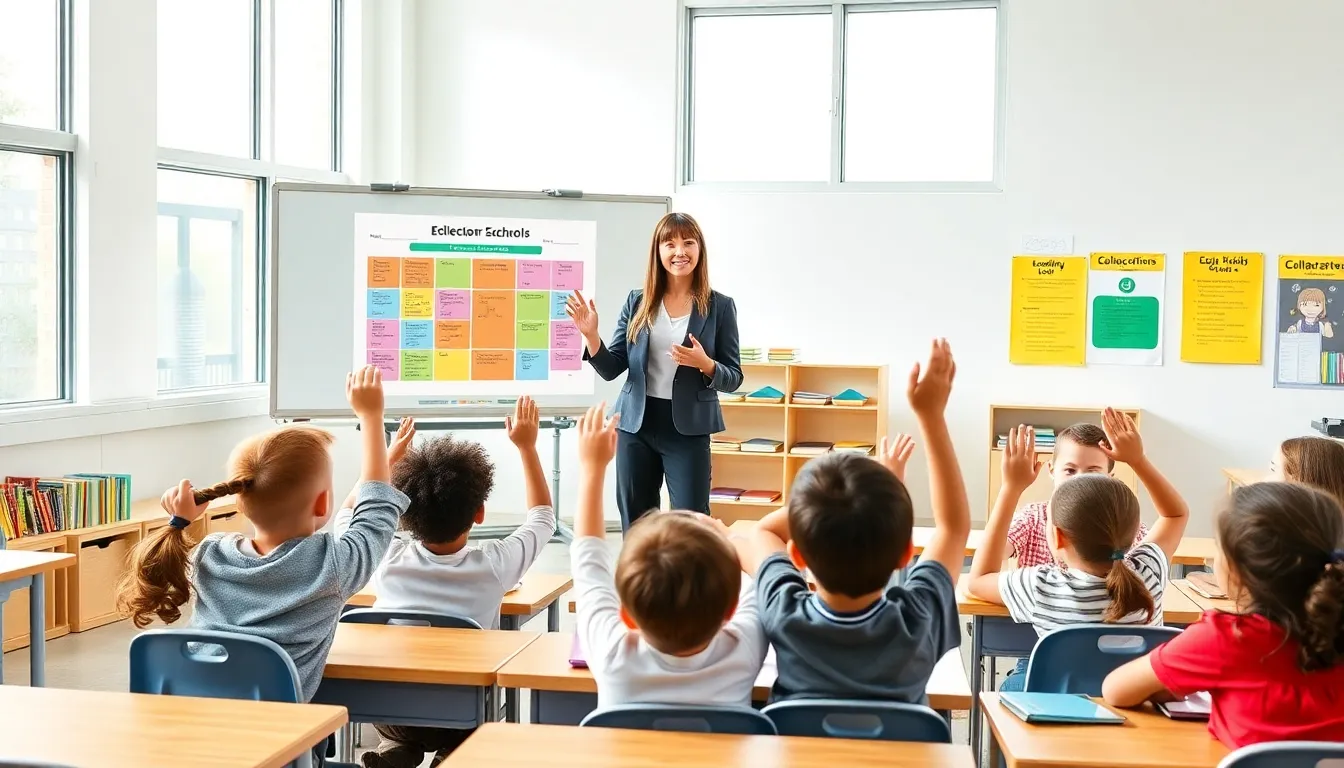
Young learners retain information better when they participate actively. Passive listening leads to limited retention, especially for elementary-aged children who need movement and interaction. Active learning techniques transform students from observers into participants.
Hands-on activities bring abstract concepts to life. A lesson on fractions becomes memorable when students divide actual pizzas or fold paper into equal parts. Science experiments let children test hypotheses themselves rather than just reading about results.
Elementary school strategies that incorporate movement yield impressive results. Brain breaks, short physical activities between lessons, help students reset their focus. Movement-based learning, like acting out vocabulary words or creating human number lines, engages multiple senses.
Collaborative learning offers another powerful tool. Partner work and small group projects teach cooperation while reinforcing content. Students often explain concepts to peers in language that resonates better than teacher explanations.
Effective elementary school strategies also include:
- Think-pair-share discussions
- Learning stations with rotating activities
- Games that reinforce academic skills
- Project-based learning opportunities
The key is variety. Students have different learning preferences, and mixing instructional methods keeps everyone engaged. A classroom that shifts between individual work, group activities, and whole-class instruction maintains energy and attention throughout the day.
Differentiated Instruction for Diverse Learners
Every classroom contains students with different abilities, backgrounds, and learning styles. Effective elementary school strategies account for this diversity through differentiated instruction. This approach adjusts content, process, or products based on individual student needs.
Differentiation doesn’t mean creating separate lessons for each child. Instead, teachers offer multiple pathways to the same learning goal. A reading group might include texts at different levels that all address the same theme. Math centers can provide activities ranging from concrete manipulatives to abstract problem-solving.
Assessment drives good differentiation. Teachers need accurate data about what each student knows and can do. Pre-assessments reveal starting points, while ongoing formative assessments track progress. This information guides instructional decisions and grouping choices.
Flexible grouping keeps differentiation dynamic. Students might work in one group for reading and a different group for math. Groups should change based on current performance, not fixed labels. This prevents students from feeling stuck in a “low” group permanently.
Elementary school strategies for differentiation include tiered assignments, learning menus, and scaffolded support. Tiered assignments offer the same core task at varying complexity levels. Learning menus let students choose from several options that all meet the objective. Scaffolds provide temporary supports that teachers gradually remove as students gain independence.
Struggling learners and advanced students both benefit from differentiation. Meeting students where they are, and pushing them slightly beyond, creates optimal learning conditions for everyone.
Fostering Social-Emotional Development in the Classroom
Academic skills matter, but social-emotional development proves equally important for elementary students. Children who can manage emotions, build relationships, and make responsible decisions become better learners. Strong elementary school strategies address the whole child, not just cognitive growth.
Explicit instruction in social-emotional skills gives students tools they can use immediately. Teachers can dedicate time to lessons on identifying emotions, resolving conflicts, and showing empathy. Role-playing scenarios let students practice these skills in safe settings.
Classroom culture reinforces social-emotional learning daily. Morning meetings create community and give students a platform to share. Collaborative norms teach cooperation and respect. Teachers who model emotional regulation show students how adults handle frustration or disappointment.
Elementary school strategies for social-emotional development also involve:
- Designated calm-down spaces in classrooms
- Feelings check-ins throughout the day
- Literature that explores emotional themes
- Peer mediation programs for conflict resolution
Positive behavior support systems encourage good choices. Rather than focusing primarily on consequences for misbehavior, these systems reward students for meeting expectations. Clear expectations, consistent reinforcement, and restorative practices create classrooms where students feel valued.
When students feel emotionally safe, they take academic risks. They ask questions, attempt challenging problems, and recover from mistakes. Social-emotional skills provide the foundation for all other learning.
Strengthening the Home-School Connection
Parents and teachers form a partnership that benefits students significantly. Elementary school strategies extend beyond classroom walls when families get involved. Strong home-school connections lead to better attendance, higher achievement, and improved behavior.
Communication builds this partnership. Teachers should reach out early and often, not just when problems arise. Regular updates about classroom activities, upcoming events, and student progress keep parents informed and engaged. Digital tools like classroom apps and email make communication convenient for busy families.
Parent involvement takes many forms. Some families volunteer in classrooms or chaperone field trips. Others support learning at home by reading with children, helping with assignments, or extending school topics through conversation. Elementary school strategies should accommodate different family situations and availability.
Teachers can share specific ways parents can help at home:
- Reading together for 20 minutes daily
- Discussing the school day over dinner
- Playing math games that reinforce number sense
- Establishing consistent assignments routines
Cultural responsiveness strengthens home-school partnerships. Teachers who learn about families’ backgrounds, values, and languages build trust. They can incorporate students’ cultures into classroom instruction, making learning more relevant and welcoming.
When parents and teachers work together, students receive consistent messages about expectations and priorities. This alignment reinforces elementary school strategies across settings and maximizes their impact.