
Table of Contents
ToggleFinding fresh elementary school ideas can transform an ordinary classroom into a space where curiosity thrives. Young learners absorb information best through hands-on activities, creative projects, and playful exploration. Teachers and parents often search for new ways to keep students engaged while building foundational skills.
This guide offers practical elementary school ideas across subjects, art projects, group games, and science experiments. Each activity aims to spark interest and make learning stick. Whether teaching reading, math, or science, these ideas help educators create meaningful experiences that students remember long after the lesson ends.
Key Takeaways
- Hands-on elementary school ideas like math scavenger hunts and science experiments make learning feel like play rather than work.
- Art projects using recycled materials and nature items develop creativity while teaching responsibility and observation skills.
- Movement-based games and team challenges keep students engaged by combining physical activity with academic practice.
- Connecting lessons to student interests and offering project choices dramatically increases engagement and ownership.
- Simple science experiments like volcano models and egg drop challenges teach foundational concepts through memorable, hands-on discovery.
- Building classroom rituals and involving families extends learning beyond school hours and creates lasting memories.
Engaging Classroom Activities for Every Subject
Great elementary school ideas often start with activities that connect lessons to real life. Students pay closer attention when they see how skills apply outside the classroom.
Reading and Language Arts
Story mapping helps students visualize plot structure. After reading a book, children draw characters, settings, and key events on a large poster. This activity builds comprehension and lets students express creativity.
Word walls grow throughout the year. Students add new vocabulary words with illustrations. The visual display reinforces spelling and definitions without rote memorization.
Math Activities
Math scavenger hunts turn numbers into an adventure. Teachers hide index cards with problems around the room. Students solve each problem to find the next clue. This approach makes practice feel like a game rather than a chore.
Manipulatives like base-ten blocks, fraction tiles, and counting beads give abstract concepts a physical form. Students who struggle with worksheets often excel when they can touch and move objects.
Social Studies
Creating a classroom economy teaches money management and responsibility. Students earn “class cash” for completing tasks and spend it at a weekly store. They learn about budgeting, saving, and making choices, skills that serve them for life.
Timeline projects help students understand historical sequences. Each child researches an event and adds it to a class timeline on the wall. The collaborative display shows how events connect across decades or centuries.
Fun Art and Craft Projects
Art projects rank among the most popular elementary school ideas for good reason. Creative work develops fine motor skills, self-expression, and problem-solving abilities.
Seasonal Crafts
Handprint art adapts to any holiday or season. A handprint becomes a turkey in November, a wreath in December, or flowers in spring. Students love seeing their own hands transformed into artwork they can take home.
Nature collages use leaves, twigs, and flowers collected during outdoor walks. Students arrange materials on cardstock and glue them down. This project connects art to science and encourages observation of the natural world.
Recycled Material Projects
Cardboard box creations challenge students to build robots, houses, or vehicles from discarded boxes. The open-ended nature of this project sparks imagination. Two students might start with identical materials and create completely different results.
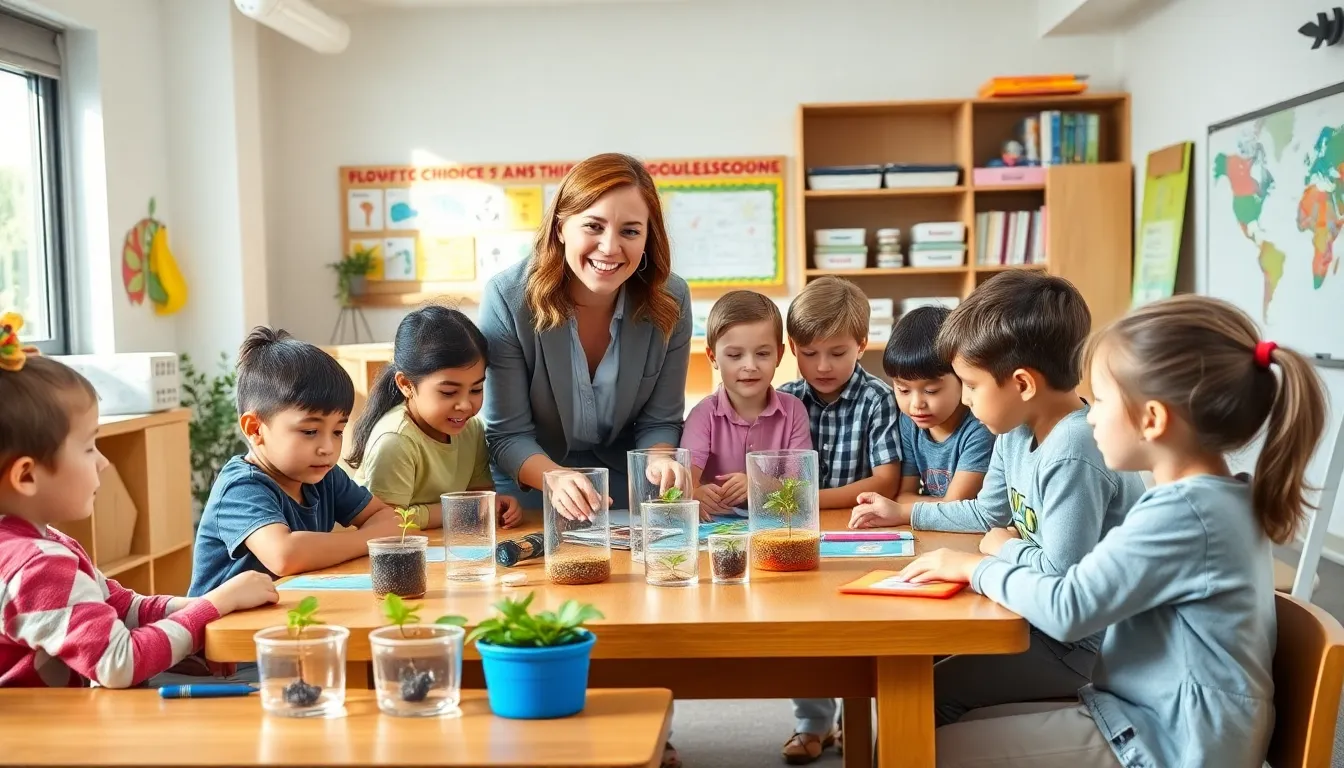
Plastic bottle planters teach recycling and plant care simultaneously. Students cut bottles, decorate them with paint, add soil, and plant seeds. Watching seeds grow over weeks reinforces patience and responsibility.
Collaborative Art
Class murals bring students together around a shared vision. Each child contributes one section to a larger picture. The finished piece hangs in the hallway, reminding students that their individual efforts create something bigger.
Interactive Learning Games and Group Activities
Games turn practice into play. These elementary school ideas encourage cooperation, communication, and friendly competition.
Movement-Based Games
Four corners quizzes get students out of their seats. The teacher labels each corner with an answer option. After hearing a question, students move to the corner they believe is correct. This activity reveals understanding quickly and keeps energy levels high.
Simon Says with educational twists reinforces vocabulary and listening skills. “Simon says touch something rectangular” sends students hunting for shapes. “Simon says spell ‘because’ with your arms” makes spelling physical and memorable.
Team Challenges
Relay races with academic tasks combine physical activity with learning. Teams race to solve math problems, spell words, or identify states on a map. The competitive element motivates students who might otherwise disengage.
Escape room challenges require teams to solve puzzles and find clues. Teachers design rooms around curriculum content. Students must apply what they’ve learned to “escape” before time runs out.
Partner Activities
Think-pair-share structures give every student a voice. Students first consider a question alone, then discuss with a partner, and finally share with the class. Shy students gain confidence by practicing their answers in a low-pressure setting first.
Easy Science Experiments for Young Minds
Science experiments rank high among memorable elementary school ideas. Hands-on discovery teaches the scientific method while satisfying natural curiosity.
Kitchen Science
Volcano models never lose their appeal. Students build mountains from clay or papier-mâché, then add baking soda and vinegar for a fizzy eruption. This classic experiment demonstrates chemical reactions in a dramatic, unforgettable way.
Density towers use household liquids like honey, dish soap, water, and oil. Students layer liquids in a clear container and observe how they separate. Adding small objects shows which layers support different weights.
Plant Experiments
Growing beans in clear cups lets students watch roots and stems develop. They can test variables like light exposure, water amounts, or soil types. Recording observations in journals builds scientific writing skills.
Celery dye experiments show how plants absorb water. Students place celery stalks in colored water and watch the color travel up the stem. Cutting the stalk reveals colored channels inside.
Physics Fun
Egg drop challenges teach engineering principles. Students design containers to protect raw eggs from a fall. Testing day brings excitement, laughter, and valuable lessons about impact absorption.
Simple machines scavenger hunts help students identify levers, pulleys, and wheels in everyday objects. A stapler becomes a lever. A window blind becomes a pulley. Suddenly, physics is everywhere.
Tips for Making Learning Memorable
The best elementary school ideas share common traits. These tips help educators maximize the impact of any activity.
Connect to Student Interests
Knowing what students care about transforms ordinary lessons. A child who loves dinosaurs might write stories about prehistoric creatures. A student passionate about soccer could solve word problems about game statistics. Personal relevance increases engagement dramatically.
Build in Choice
Offering options gives students ownership of their learning. Instead of assigning one book report format, teachers might offer three options: a poster, a diorama, or a recorded book review. Students work harder on projects they chose themselves.
Celebrate Effort and Progress
Recognizing growth matters more than praising perfection. Display boards showcasing “works in progress” normalize the learning process. Students understand that mistakes lead to improvement.
Create Rituals and Traditions
Weekly events give students something to anticipate. “Fun Fact Friday” or “Mystery Monday” builds excitement around learning. Students remember these traditions years later.
Involve Families
Sending home simple extension activities keeps learning alive beyond school hours. Families appreciate clear, easy-to-follow instructions. A parent doesn’t need a teaching degree to ask follow-up questions about a class project.